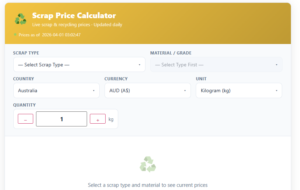
How Do Scrap Dealers Decide Price? (Complete Pricing Formula Explained for 2026)
Many sellers often wonder how scrap dealers decide price, especially when they receive different offers for the same material. This confusion usually comes from a lack of transparency in pricing methods. As a result, sellers may accept lower rates without understanding how dealers calculate value.
How Do Scrap Dealers Decide Price? (Core Formula)
In simple terms, scrap dealers use this pricing logic:
Scrap Price = Base Metal Rate – Costs – Dealer Margin
Where:
- Base Metal Rate = Global market price
- Costs = Transport, processing, labor
- Margin = Dealer profit
Therefore, final price is always lower than market metal price.
Key Factors Scrap Dealers Use to Decide Price
1. Global Metal Prices
First and foremost, scrap pricing is linked to global metal rates.
- Copper, aluminum, steel prices fluctuate daily
- Dealers track international benchmarks
As a result, scrap prices increase when metal markets rise.
2. Scrap Type & Material
Secondly, different materials have different values.
| Material | Value Level |
|---|---|
| Copper | Very High |
| Aluminum | Medium |
| Steel | Low |
| Brass | High |
Therefore, dealers pay based on metal type and demand.
3. Scrap Quality & Purity
Not all scrap is equal, and quality significantly affects pricing.
- Clean, sorted scrap → Higher rates
- Mixed or contaminated scrap → Lower rates
Consequently, better quality increases price by 20–40%.
4. Quantity (Bulk vs Small)
Additionally, quantity plays a major role.
- Bulk scrap → Higher price per kg
- Small quantity → Lower price
Because of this, industries get better rates than individuals.
5. Local Demand & Supply
Moreover, dealers consider regional market conditions.
- High demand → Higher prices
- Oversupply → Lower prices
As a result, prices vary by location.
6. Processing & Handling Costs
Dealers subtract operational costs such as:
- Transportation
- Labor
- Sorting and cleaning
- Storage
Therefore, higher costs reduce the final price offered.
7. Dealer Profit Margin
Finally, dealers add their margin.
- Typically 5% to 20%
- Depends on risk and market conditions
Consequently, negotiation can reduce this margin.
Scrap Price Calculation Example
Let’s break it down:
| Component | Value |
|---|---|
| Copper market price | $10/kg |
| Processing cost | $1/kg |
| Transport cost | $0.5/kg |
| Dealer margin | $1/kg |
| Final scrap price | $7.5/kg |
Clearly, costs and margins significantly affect pricing.
Scrap Prices Reference (2026)
| Material | USD/kg | AUD/kg |
|---|---|---|
| Copper | $7 – $11 | $10 – $17 |
| Aluminum | $2 – $3.5 | $3 – $5 |
| Steel | $0.3 – $0.7 | $0.5 – $1 |
| Brass | $4.5 – $7.5 | $7 – $11 |
Keep in mind, dealers adjust these rates daily.
How to Get Better Prices from Scrap Dealers
Improve Scrap Quality
- Clean and segregate materials
As a result, dealers offer higher rates
Sell in Bulk
- Larger quantities attract better pricing
Therefore, consolidate scrap before selling
Compare Multiple Buyers
- Don’t rely on one dealer
Consequently, competition increases price
Use Online Scrap Platforms
- List on global scrap trading marketplace
- Then, connect with exporters via Australian scrap buyers network
- Additionally, use instant scrap selling platform
Thus, you can bypass low local offers.
Common Mistakes Sellers Make
- Not knowing market prices
- Selling mixed scrap
- Accepting the first offer
- Ignoring bulk advantage
- Not negotiating
Because of this, sellers lose 20–50% value.
FAQs: How Do Scrap Dealers Decide Price?
How do scrap dealers calculate scrap price?
They use a formula based on metal price, costs, and profit margin, then adjust based on quality and demand.
Why do dealers offer lower prices than market rates?
Because they deduct costs and margins, including transport and processing expenses.
Does scrap quality affect price?
Yes, clean and sorted scrap gets significantly higher rates.
Can I negotiate scrap prices?
Absolutely, especially if you have bulk quantity or high-quality scrap.
Do all dealers offer the same price?
No, prices vary based on location, demand, and dealer margins.
Conclusion
To sum up, scrap dealers decide prices based on global metal rates, scrap quality, costs, and profit margins. While these factors may seem complex, understanding them gives you a clear advantage in negotiations.